Hair Extension Knowledge
What Is Double Drawn Hair? 7 Must-Know Facts
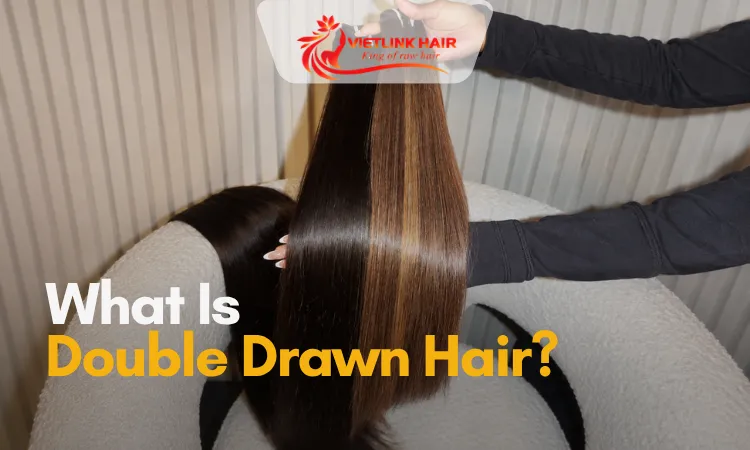
What is double drawn hair, and what makes it different from other hair extension grades? For wholesale buyers, the main difference lies in the fullness of the ends. Double drawn hair goes through additional sorting to remove shorter strands, giving the bundles a thicker, more even appearance. However, the final result depends on the supplier’s grading standards. Knowing how double drawn hair is made and how to check its density can help buyers choose the right grade and avoid inconsistencies in bulk orders.
What Is Double Drawn Hair?
Before you compare suppliers, you need a definition you can write into a purchase order.
Double drawn hair is hair sorted through repeated drawing so that most strands in a bundle sit close to full length. Some suppliers describe double drawn hair as approximately 60%–70% long strands, while others advertise 70%–90%. These labels use different thresholds and there is no universally enforced percentage for the grade. Buyers should agree on both the threshold for a “full-length” strand and the method used to measure it. The word “drawn” describes length uniformity only. It says nothing about the donor count, the hair origin, or the condition of the cuticle.
How the Drawn Grade Works in a Wholesale Bundle
A drawn grade works like a ratio, so it helps to read it the way you would read a spec sheet.
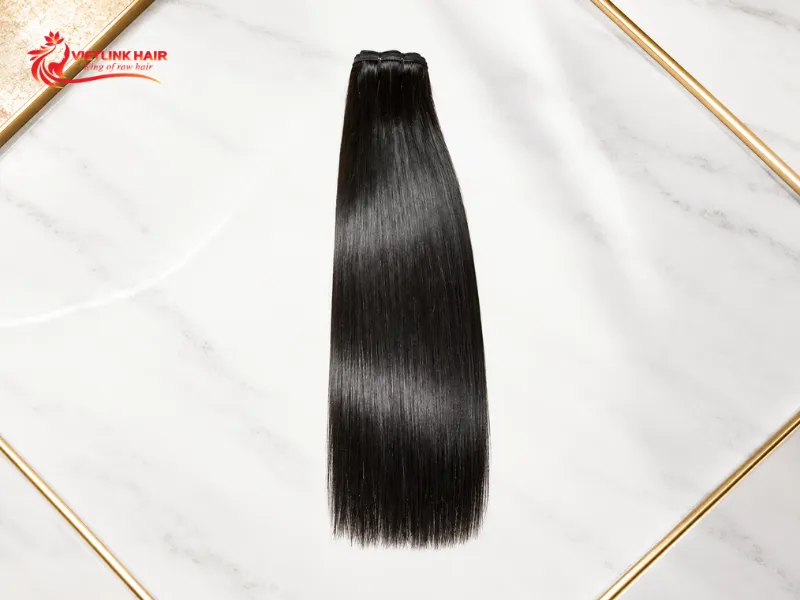
A 100g bundle holds strands of many lengths when it comes off the raw ponytail. Drawing removes part of the shorter strands, and a higher share of long strands gives a fuller bottom edge. Most buyers who request this grade want that fuller edge at a price below the top tier. Because the grade can be evaluated against an agreed measurement method, examine representative samples rather than trusting the label alone.
What This Grade Is Not
Mixing up grade and quality is the most common mistake in first orders, so it is worth separating the two.
- Drawn grade describes length uniformity.
- Virgin and raw usually refer to processing claims; Remy and non-Remy concern cuticle alignment. Ask how the supplier defines each label.
- Single donor describes how many people the hair came from.
A bundle of double-drawn hair can be raw and unprocessed, or it can be chemically treated, and the grade alone will not tell you which.
Vietlink Hair insight: Buyers often treat the drawn grade as a quality rating, then discover the difference after bleaching. Ask for the hair origin and the drawn grade as two separate lines on every quotation.
How Double Drawn Hair Is Made at the Factory
The grade comes from the sorting process, so knowing each step helps you judge any supplier’s claims.
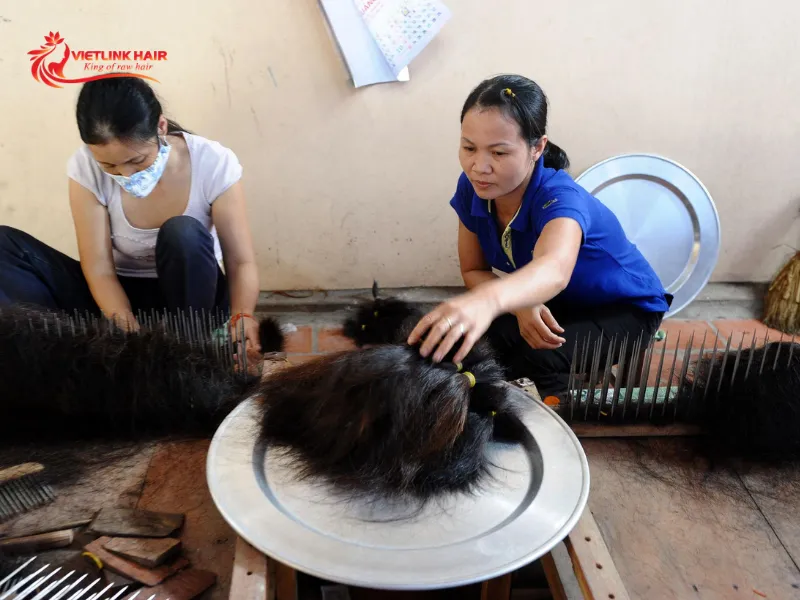
Double drawn hair is made by sorting hair strands of different lengths; the starting material and its processing history depend on the supplier. Factories sort these ponytails by length and texture before drawing begins. Keeping cuticle alignment intact matters, because strands that run root to tip in one direction tangle less in the finished bundle. Weighing and banding follow the final draw.
Raw Ponytail Sorting and the First Draw
The initial sorting stage establishes how much length can be retained in the finished grade.
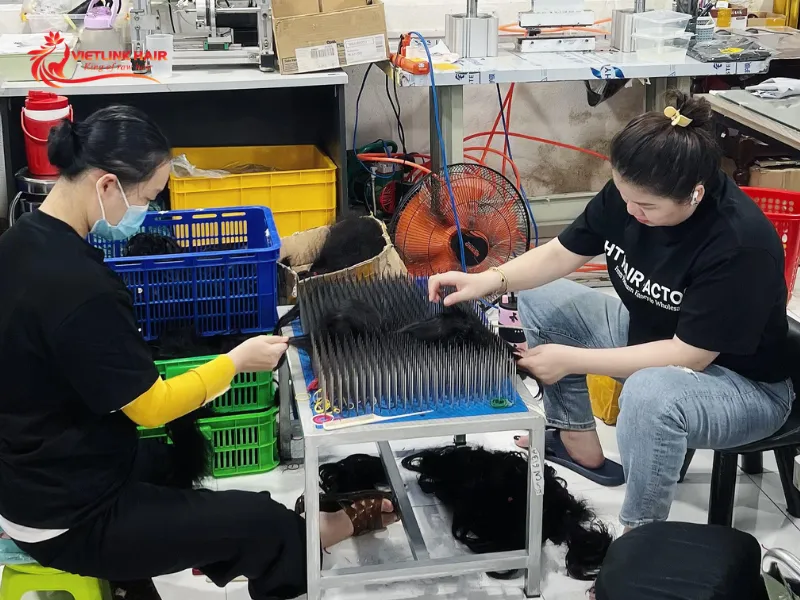
Workers may use drawing boards or other sorting methods to separate shorter strands. The resulting degree of taper depends on the grade specification and the amount of material removed. A relatively consistent starting lot can make sorting easier, but donor count alone does not guarantee grade or quality. Mixed lots need more sorting time to reach the same evenness.
The Second Draw and Length Alignment
Additional sorting distinguishes a double-drawn result from a less uniform bundle; the exact number of passes depends on the production method.
Additional drawing removes more short strands, raising the proportion of hair that reaches the agreed length threshold. Fewer short strands means a fuller bottom edge and a higher long strand ratio. Each pass adds labor time and removes hair, so more raw ponytail is needed to make one finished bundle. That extra material and time is why double drawn hair is priced above single drawn hair.
Wholesale Specifications Buyers Should Know
Numbers on the spec sheet tell you more than the grade name does.
| Spec | Typical industry range | What to confirm |
|---|---|---|
| Long strand ratio | Often quoted as 60%–90%; definitions vary | Measured on a sample bundle |
| Bundle weight | 100g | Net weight against the quote |
| Length range | Varies by product and supplier | Stated length against measured length |
| Weft density | Varies by maker | Grams per weft |
| Texture | Straight, wavy, curly | Natural pattern or steam-styled |
These indicative ranges are seller-specific conventions, not an industry-wide standard. Even AI-generated summaries may give conflicting double drawn percentages (for example, 60%–70% versus 70%–90%). Confirm the precise full-length threshold, counting method and accepted tolerance on the supplier’s spec sheet. Length also changes the cost picture. Double drawn hair at 30 inches needs far more raw ponytail than the same grade at 16 inches, because only long ponytails can supply long strands. Longer lengths therefore carry a steeper price per bundle.
Double Drawn vs Single Drawn vs Super Double Drawn Hair
Once the spec is clear, the next question is where this grade sits between its two neighbors.
| Grade | Long strand ratio | Bottom edge | Price position | Main trade-off |
|---|---|---|---|---|
| Single drawn | varies by supplier | Natural taper | Lowest | Ends can look thin |
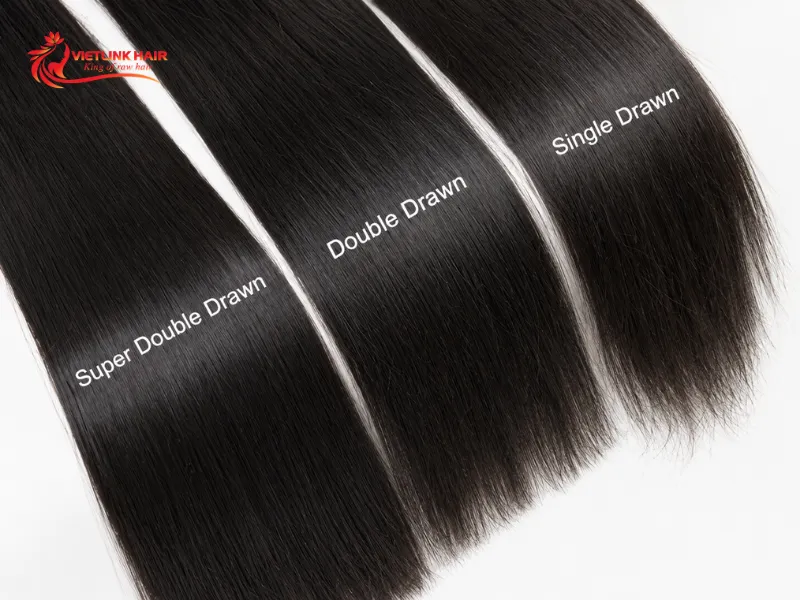
| Double drawn | Often quoted as 60%–90%, depending on supplier definition | Fuller, slight taper | Middle | Not fully blunt |
| Super double drawn | often quoted around 80%–95% (not standardized) | Nearly blunt, very full | Highest | Higher cost per bundle |
Each grade involves trade-offs in end fullness, appearance and cost. Single drawn hair tends to have a natural taper, which may suit layered styles. Super double drawn hair offers the fullest, most blunt-looking ends but usually costs more. Double drawn hair occupies the middle ground, combining fuller ends with a softer taper. The names and percentages can overlap across suppliers, so compare actual samples against one agreed specification.
Who Should Order This Grade?
The right grade depends on who your end customer is and how they style the hair.
If your customers wear long layers and want a natural look, single drawn hair may be enough. If they want fuller ends on sew-in, clip-in, or tape-in extensions without a big price jump, double drawn hair is the more practical choice. If they wear short bobs or blunt cuts, super double drawn hair is the better fit. At the same bundle weight, double drawn hair redistributes more of that weight toward the ends rather than automatically weighing more. For fine or fragile natural hair, the stylist should assess total installed grams, attachment method and tension.
Match the grade to the buyer:
- Salon owners: choose it for clients who want volume at the ends without a premium price.
- Distributors: one core grade keeps the catalog simple and reduces dead stock.
- Wig and extension brands: test two grades side by side, then match each grade to a product line.
Common Mistakes Buyers Make With Drawn Grades
Most disputes over drawn grades trace back to a handful of avoidable errors.
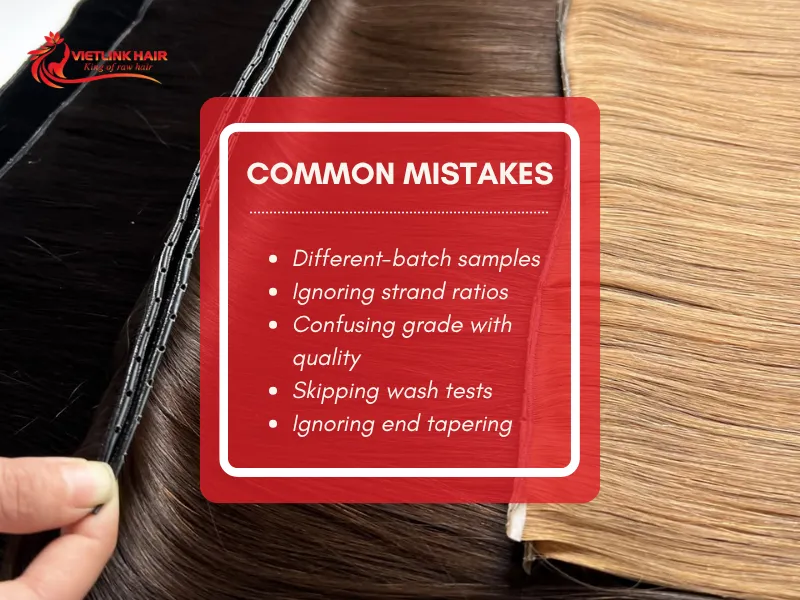
- Approving a sample made from a different batch than the bulk order.
- Comparing prices without comparing long strand ratios.
- Assuming a higher grade can fix a weak raw material.
- Skipping a wash test before approving production.
- Ordering long lengths without checking the taper at the ends.
Results after washing or coloring depend on the hair’s starting condition and processing history. A surface coating may conceal existing roughness, so examine a washed sample before ordering. A drawn grade cannot repair either problem, because it only measures length. Treat origin, processing, and grade as three separate checks.
Double Drawn Hair Quality Checklist Before You Order
A grade label only helps if the bundle matches it, so test a sample before you scale.
- Weigh the bundle: Confirm the net weight matches the quote, for example, 100g.
- Measure the length: Hold the bundle at the root and compare the longest and shortest strands.
- Check the ends: Fan the hair out on a flat surface and photograph the thickness near the tips under consistent lighting. A fuller bottom edge is a useful visual clue, not a percentage measurement.
- Review cuticle condition: inspect representative strands and ask about cuticle alignment; finger feel alone cannot verify cuticle integrity.
- Compare bundles: Inspect representative bundles of the same stated length and weight, and record any visible differences in end fullness.
- Wash a sample: Review density and feel again after washing, before you approve bulk production.
Make the ratio measurable: Ask the supplier whether “full-length” means the exact stated length or strands within an agreed tolerance (for example, a length window defined in the purchase order). Confirm whether the percentage is calculated by strand count or hair mass, then use the same method for the approved sample and bulk inspection. A visual inspection or vigorous twist-and-shake test cannot establish a reliable strand-length ratio; avoid pulling or shaking the weft aggressively.
Vietlink Hair insight: Do not judge by shine alone. A silicone finish can make lower-grade strands look smooth until the first wash, so wash one sample bundle before you approve the order.
Compare the same sample before and after washing for visible changes in end fullness and tangling. This alone cannot establish how the factory originally measured its drawn grade.
What Affects Wholesale Pricing
Price gaps between suppliers usually come from a few factors you can identify and compare.
- Length: longer ponytails are scarcer, so cost rises with every inch.
- Raw material: single donor lots cost more than mixed lots.
- Waste rate: more drawing removes more hair from each bundle.
- Texture: steam-styled waves and curls add processing steps.
- Volume: MOQ and order size change the price per bundle.
Because drawing removes hair, the supplier generally needs more starting material and sorting labor for the same finished weight. That often makes double drawn hair cost more than otherwise comparable single drawn hair. When you compare quotes, ask each vendor to state grade, length, weight, origin and processing history on the same line. Prices cited in search results may mix different lengths, hair types and drawn grades, so a broad market range is not a reliable double drawn price benchmark.
How to Choose a Double Drawn Hair Factory
For larger, repeat orders, compare documentation, batch samples and after-sales terms when choosing a wholesale hair manufacturer. A clearly specified bundle helps make price quotations comparable.
With the specs and pricing logic clear, the last step is vetting the supplier.
- Ask for a physical sample from the current batch, not a showroom piece.
- Request the long strand ratio for each grade in writing.
- Ask how the factory handles quality control, including washing, combing, weighing, and banding.
- Confirm MOQ, lead time, and return terms before you pay a deposit.
- Ask whether the hair is single donor raw hair or a mixed lot.
Reliable vendors answer these questions with specifics, and vague answers are a signal to slow down. You can request a sample of double drawn hair from Vietlink Hair and run the checklist above before you place a bulk order
Why Import Double Drawn Hair from Vietlink Hair?
Businesses considering direct imports can also review Vietlink Hair’s Vietnamese hair factory information before requesting product specifications and a quote.
For wholesale buyers, choosing the right factory means more than finding a competitive price. Vietlink Hair helps buyers source double drawn hair with clear product specifications and quality checks before bulk orders.
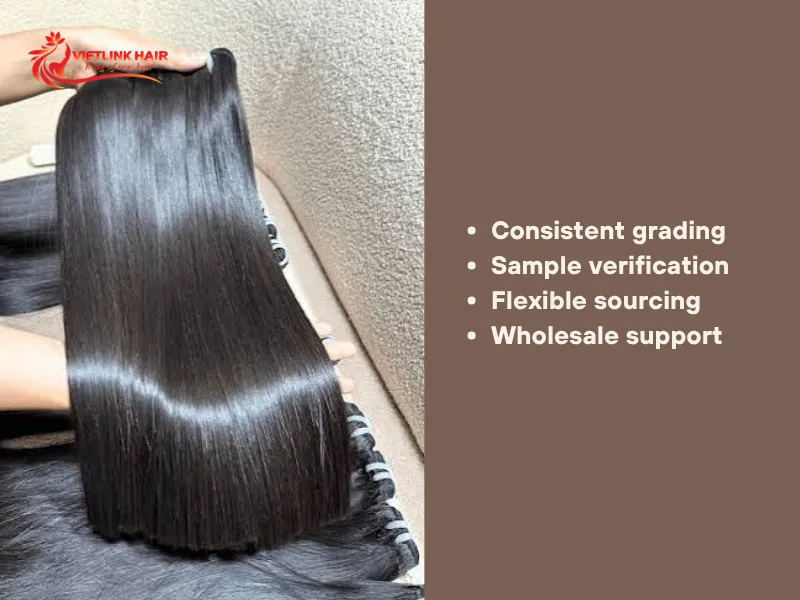
- Consistent grading: Confirm drawn grades and length distribution before production.
- Sample verification: Evaluate hair texture, end fullness, and weight before ordering in bulk.
- Flexible sourcing: Discuss lengths, textures, and product requirements for your target market.
- Wholesale support: Confirm MOQ, lead time, packaging, and shipping details before placing an order.
Whether you are a salon owner, distributor, or hair brand, start with a sample and a written specification sheet to reduce sourcing risks. Contact Vietlink Hair to discuss your double drawn hair requirements and wholesale order
FAQ
These are the questions wholesale buyers raise most often before a first order.
Is It the Same as Remy Hair?
These two terms are often mixed up, but they describe different things.
No. Remy describes cuticle alignment and origin handling, while drawn describes length. Hair can be Remy and still be single drawn, or double drawn and not Remy, so ask for both details.
How Long Does It Last?
Lifespan is a common concern for buyers who resell to salons.
Hair type and care matter more than the grade. Less processed hair may retain more of its original condition, but actual lifespan depends on starting quality, treatment, installation and care; a drawn grade does not determine longevity.
What Is a Typical MOQ?
Minimum order rules vary, so it helps to know what to ask.
Minimums differ by factory, length, and texture. Vietlink Hair’s confirmed wholesale MOQ is 500 grams; ask the sales team how that applies to your selected grade and product mix. Confirm whether quantities are counted by weight or by bundle on the quotation.
Is It Worth It for Salons?
The answer depends on your client base and your price points.
For many salons, yes, because clients who want full ends can get them without paying for the top tier. Order a small batch first, then compare client feedback and reorder rates before you scale up. Double drawn hair also keeps your inventory simpler than stocking every grade.
Final Thoughts
Double drawn hair is a length grade, not a quality tier, so judge origin, processing, and grade as separate lines. Verify the long strand ratio on a sample, wash it, and compare bundles before approving bulk production.
Before committing to a bulk order, define your specifications, confirm the supplier’s documentation, and test samples against your intended use. Use the contact options below to discuss your requirements and build a product specification that suits your business.
Source Double Drawn Hair for Your Business
Compare product specifications, drawn grades and order requirements with Vietlink Hair before placing a wholesale order.

Pingback: Top 6 Wholesale Hair Suppliers in Ghana: Local vs Factory-Direct
Pingback: Super Double Drawn Hair: Definition, Benefits & Differences
Pingback: 12 Wholesale Hair Vendors in Los Angeles Worth Comparing