
Hair Extension Knowledge
Tape-In vs I-Tip Extensions: Differences, Costs, and Which Is Best?
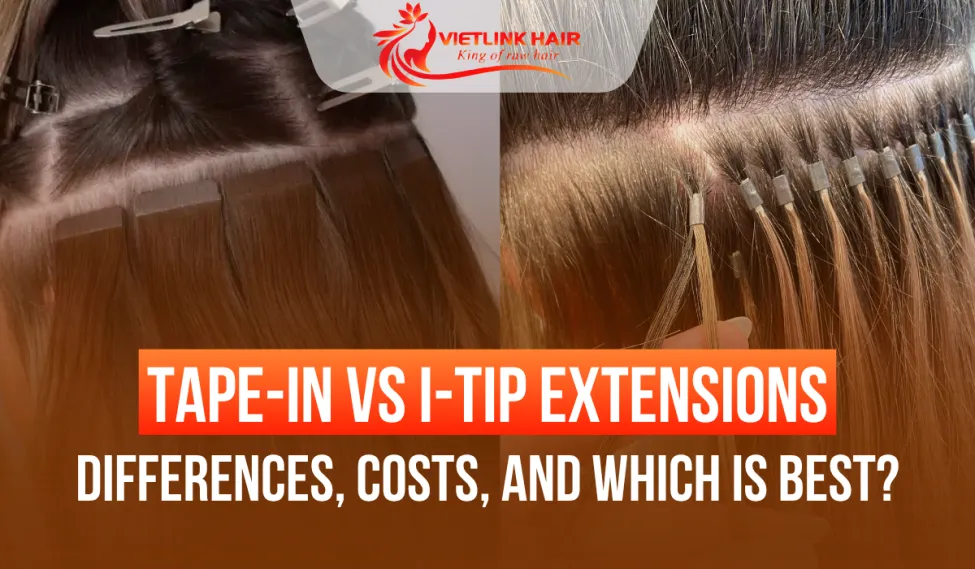
Choosing between tape-in vs I-tip extensions can be challenging when both offer a natural-looking way to add length and volume. However, differences in application, comfort, maintenance, and overall cost can make one option a better fit than the other. Whether you’re comparing extensions for personal use or deciding which products to offer your salon clients, this guide from Vietlink Hair breaks down the key differences to help you make the right choice.
What Are Tape-In Hair Extensions?
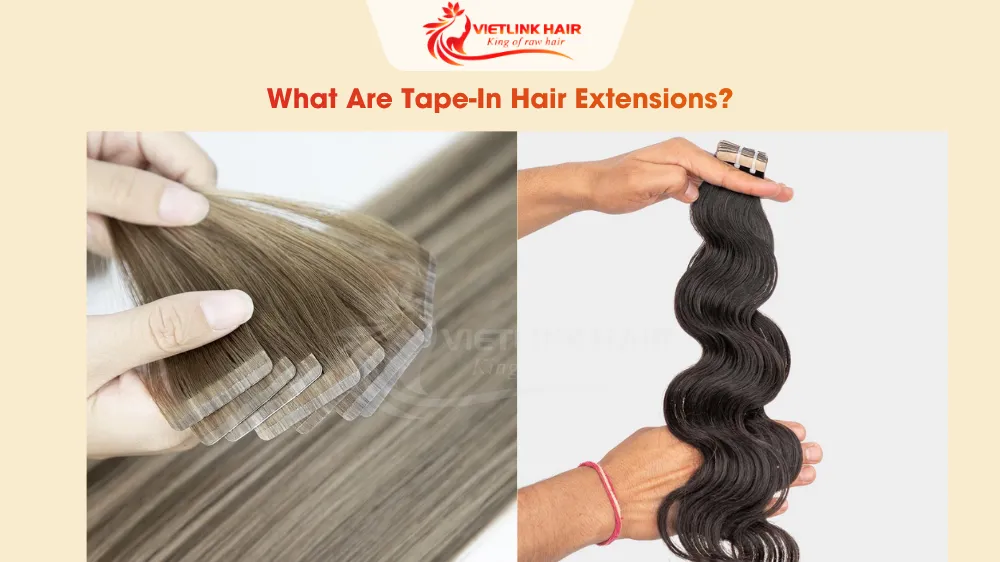
Tape-in hair extensions are semi-permanent hair extensions attached to natural hair using thin, adhesive-backed tabs. A stylist typically sandwiches a small section of natural hair between two extension tabs, creating a flat, lightweight attachment that blends discreetly with the hair. Tape-in extensions are popular for adding length and volume, especially for clients who want a smooth, natural-looking finish without bulky attachments. They generally require professional installation and periodic maintenance as natural hair grows.
What Are I-Tip Hair Extensions?
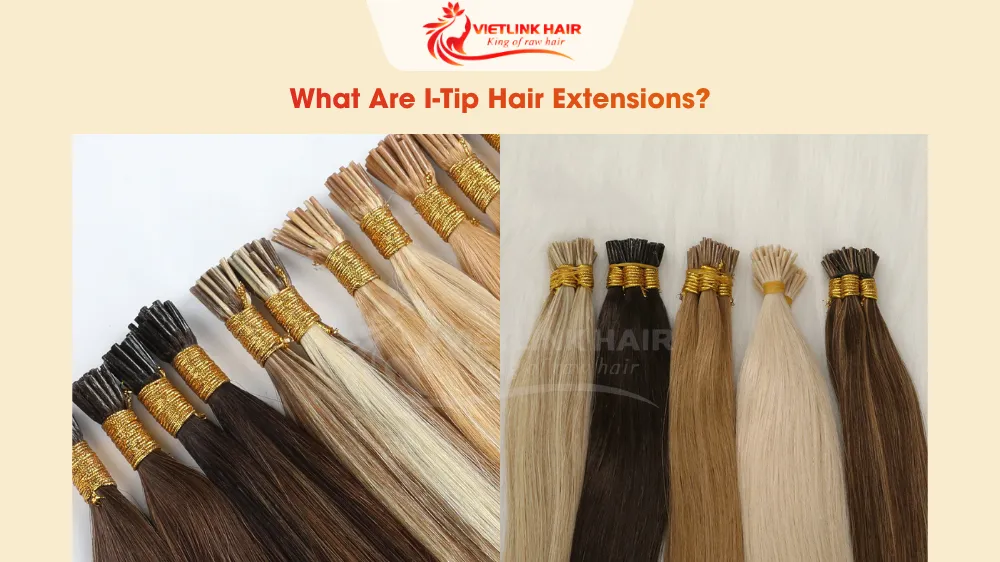
I-tip hair extensions are individual strand extensions with small, stick-shaped tips that are attached to natural hair using microbeads or micro-rings. The stylist threads a small section of natural hair through a bead, inserts the I-tip strand, and secures the connection without using adhesive glue or heat during installation. I-tip extensions allow flexible placement and natural movement, making them suitable for adding length and volume in targeted areas. They require regular maintenance to reposition the attachments as natural hair grows.
Tape-In vs. I-Tip Extensions: Key Differences
Both tape-in and I-tip extensions can be made with human hair and are semi-permanent options for adding length and volume. However, they differ in attachment methods, comfort, installation time, maintenance schedules, and long-term costs. The comparison table below highlights the key differences to help readers quickly understand how each method works and which option may better suit their needs.
| Factor | Tape-In Extensions | I-Tip Extensions |
|---|---|---|
| Attachment | Adhesive tape, hair sandwiched between two wefts | Micro bead clamped around natural hair and one strand |
| Typical weight per unit | Varies by weft and brand | Varies by strand and brand |
| Full-head quantity | Depends on desired coverage and pack weight | Depends on density, strand count and weight |
| Installation time | Often shorter; ask the salon for an estimate | Often longer due to individual placement |
| Move-up interval | Often around 6–8 weeks; confirm with stylist | Varies with hair growth and attachment condition |
| Typical lifespan of the hair | Depends on hair quality, use and care | Depends on hair quality, use and care |
| Best for | Discreet flat placement when hair condition allows | Flexible targeted placement where strands are supported |
Hair-health note: Both tape tabs and I-tip beads can create pulling when fitted too tightly or carried by fragile strands. Pain, persistent tension, scalp irritation or noticeable shedding are reasons to contact a qualified stylist promptly, not signs that an extension should simply be worn longer.
Attachment Method and Installation Time
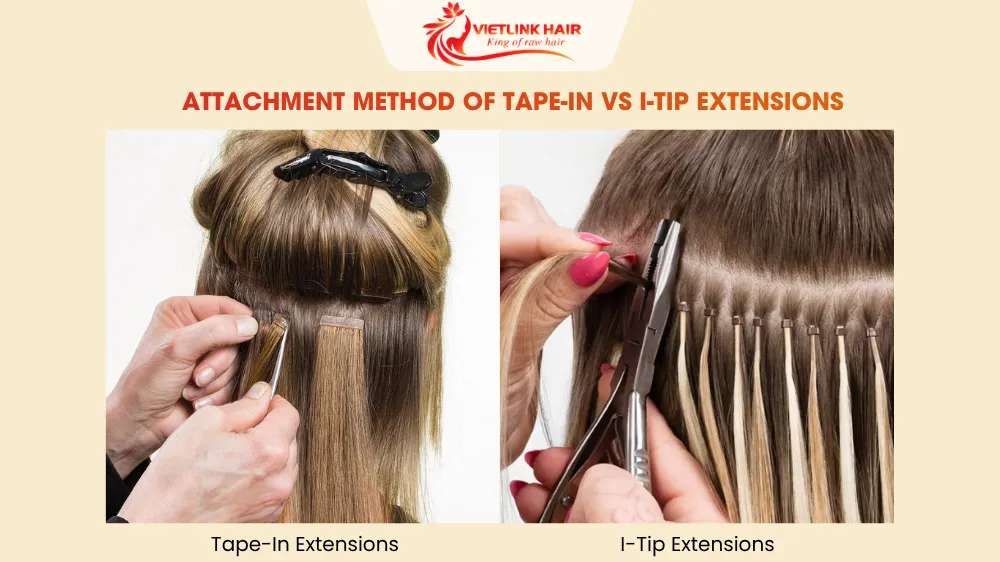
The main difference between tape-in vs. I-tip extensions lies in how they attach to natural hair. Tape-in extensions use adhesive to sandwich a thin section of natural hair between two wefts, while I-tip extensions use a mechanical attachment method in which a metal or silicone-lined bead secures a small section of natural hair and an individual extension strand.
These attachment methods also affect installation time. Tape-in extensions are applied section by section using flat panels, allowing a trained stylist to complete a full-head application in a time that depends on the number of panels, the client’s hair density and the stylist’s technique. I-tip extensions require a separate bead and strand for each small section of hair, so a full-head application usually takes longer than many panel-based installs. Thick hair or denser coverage can extend the installation time further.
Removal follows a different process for each method. Tape-in extensions are loosened with an adhesive remover, after which the wefts are separated and cleaned for reuse. I-tip extensions are removed by opening each bead with pliers and sliding the strand out. This method does not require an adhesive solvent, but bead removal still needs care to prevent pulling or breakage.
Appearance and Comfort
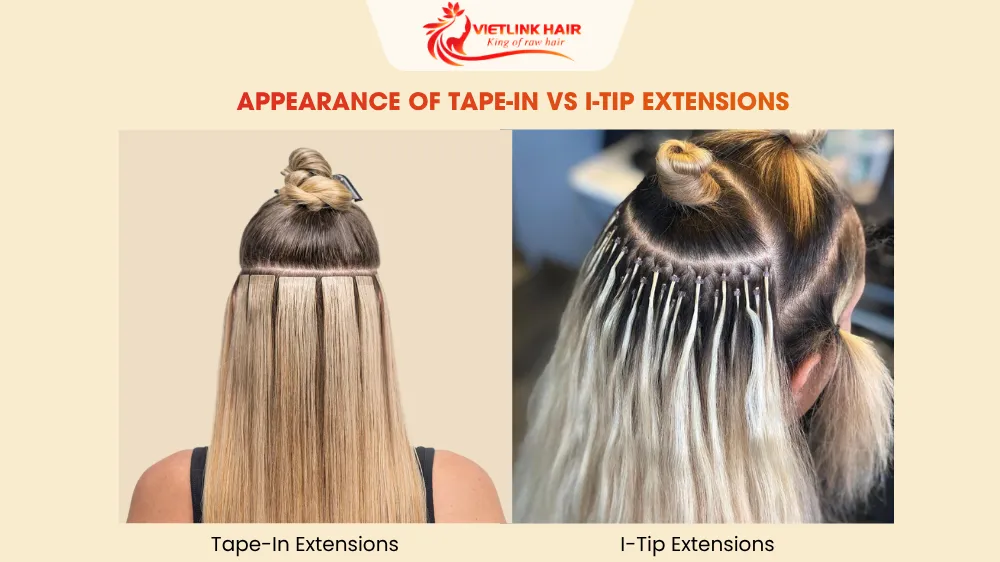
When comparing tape-in vs. I-tip extensions, appearance and comfort depend largely on how the extensions sit against the scalp, blend with natural hair, and move during styling. Tape-in extensions create a flat, smooth profile that lies close to the scalp. When properly placed, the wefts are usually invisible in straight, down styles. However, tape bonds can become visible in high ponytails or updos, particularly for clients with very fine hair or low hair density.
I-tip extensions offer more flexibility for hairstyles that expose the roots. Each strand blends with the surrounding natural hair, and the absence of a continuous tape line allows clients to wear high ponytails, change their parting angles, and style their hair with less visible attachment hardware. Although the beads are small, they sit slightly above the scalp, so clients with very short or very fine hair may notice them more.
Comfort varies from person to person. Properly fitted tape-in extensions may feel lightweight, but persistent tightness, scalp tenderness or pain should not be dismissed as a normal adjustment. With I-tip extensions, clients may feel the beads when lying on their backs or wearing a hat. Proper installation is essential for both methods, as overloaded sections, tape placed too close to the scalp, or beads clamped too tightly can create tension and discomfort.
Cost and Lifespan
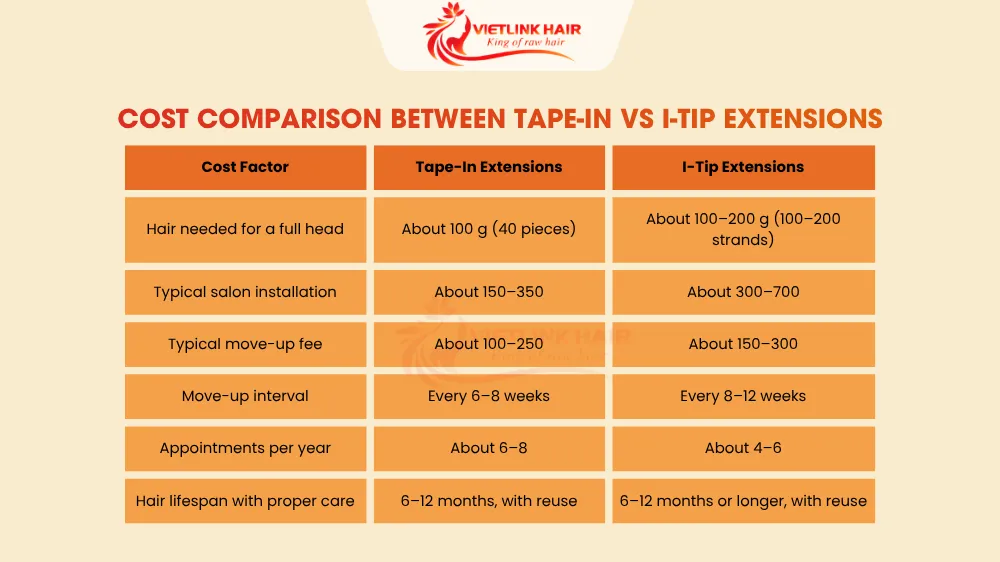
Total cost depends on the hair quantity, salon installation, removal and refit services. Tape-in and I-tip quotes are not directly comparable unless the same hair weight, hair quality and service scope are included.
| Cost Factor | Tape-In Extensions | I-Tip Extensions |
|---|---|---|
| Hair needed for a full head | Depends on density and target fullness | Depends on density and target fullness |
| Typical salon installation | Request a local, itemised salon quote | Request a local, itemised salon quote |
| Typical move-up fee | Ask salon about removal, cleaning and re-taping | Ask salon about bead removal and repositioning |
| Move-up interval | Often around 6–8 weeks; confirm with stylist | Varies with hair growth and attachment condition |
| Appointments per year | Depends on individual maintenance schedule | Depends on individual maintenance schedule |
| Hair lifespan with proper care | Product-specific; may be reused if suitable | Product-specific; may be reused if suitable |
| Replacement bonds | New adhesive tape needed at each reinstall | Use suitable replacement or approved reusable beads as advised by the stylist |
| Overall cost profile | Includes hair, fit, re-tape and refits | Includes hair, strand fitting, beads and refits |
Ask your stylist for an itemised quote covering the hair, installation, removal, refits and replacement components. Maintenance timing should follow the stylist’s assessment and the product manufacturer’s guidance.
- Hair and installation costs: A full head of tape-ins typically requires about 100 g of hair, while I-tips may require 100–200 g depending on the desired density. At a similar price per gram, I-tips can cost as much as or more than tape-ins for the hair alone, particularly when greater volume is needed. Installation labor also tends to cost more for I-tips because each strand must be attached individually.
- Maintenance and lifespan: Tape-in fittings are often checked or moved up around 6–8 weeks, while I-tip schedules vary with growth, strand load, bead security and salon protocol. Neither method has a guaranteed wear interval or hair lifespan: the reusable hair must be assessed for condition at every refit. Tape tabs are replaced during reapplication; I-tip beads should be inspected and replaced whenever worn, damaged or unsuitable for another fitting.
Tape-in appointments are often quicker than strand-by-strand I-tip fittings, but the less expensive choice depends on the hair quantity, labour rate and number of refits. Do not assume I-tips always require fewer visits: request a written maintenance schedule and compare total costs over the same period.
Reusability and Maintenance
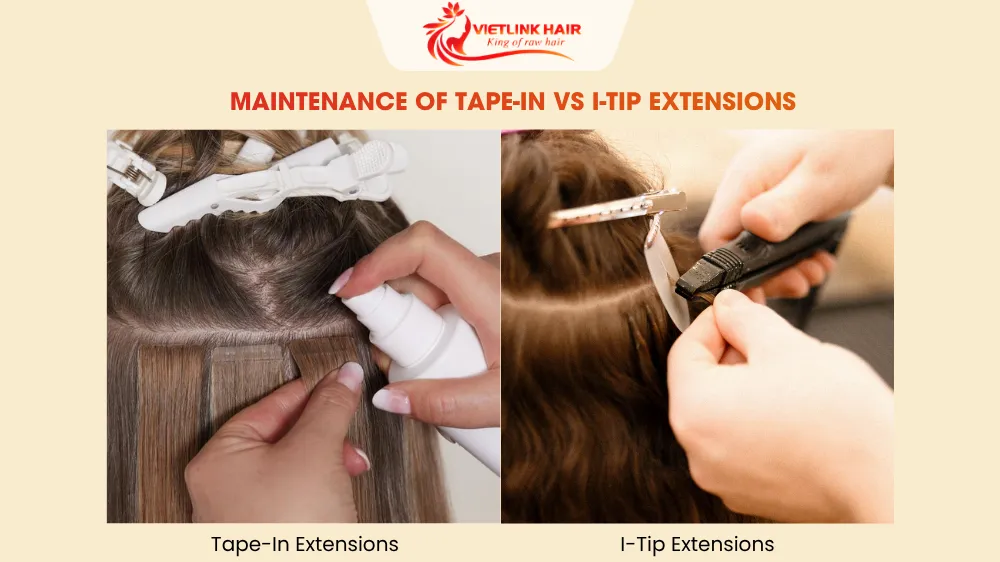
Both methods may support reuse when the extension hair and fittings remain in good condition. Each type requires different removal and reinstallation steps.
Tape-in wefts may be removed by a trained professional, cleaned and fitted with new tape tabs when suitable. The number of reuse cycles depends on the weft construction, hair condition and product guidance, not a universal maximum.
I-tip strands may be removed with suitable tools and refitted using compatible beads if the hair and tips remain suitable. A stylist should assess each attachment before reusing it.
Daily maintenance tips for both extension types:
- Wash carefully: Use a sulfate-free, moisturizing shampoo and keep conditioner away from the attachment points.
- Brush gently: Use a loop brush or soft-bristle brush, working from the ends upward. Detangle the hair before washing.
- Choose products carefully: Avoid oils, silicone-heavy serums, and heavy masks near the roots, especially with tape-in extensions.
- Protect hair while sleeping: Wear the hair in a loose braid or wrap it in a silk scarf to reduce friction.
- Use heat protection: Apply a heat protectant and keep styling tools within the product manufacturer’s recommended limits.
Both methods need professional checks: tape-in bonds may be affected by product buildup and heat near the adhesive, while I-tip beads require checks for slippage, matting and tension.
Tape-In vs I-Tip Extensions: Which Is Better for Your Needs?
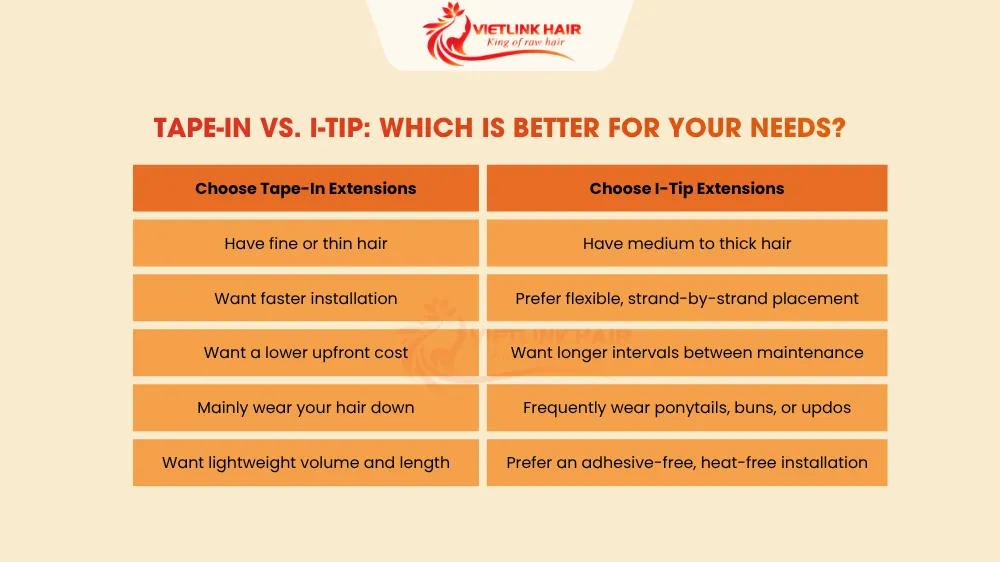
Choosing between tape-in and I-tip extensions depends on hair type, lifestyle, budget, and preferred hairstyles. Neither method is universally better; the right option depends on how the extensions will be worn, maintained, and styled.
Choose tape-in extensions if:
- You have fine hair with adequate density and a stylist confirms that lightweight, flat attachments are appropriate; fragile or thinning hair requires special assessment.
- You want a quick salon appointment, as tape-ins are one of the fastest professional extension methods to install.
- You want to add length and volume throughout the head at a lower upfront cost.
- You mainly wear your hair down, where the flat wefts can blend discreetly with natural hair.
Choose I-tip extensions if:
- You have medium to thick hair that can comfortably support individual extension bonds.
- You frequently wear ponytails, buns, or updos and want attachment points that are less visible in these styles.
- You are sensitive to adhesive or prefer an application method that does not require glue or heat.
- You prefer strand-by-strand fittings and can attend maintenance appointments according to a stylist’s guidance.
- You need precise strand placement or colour accents, provided the client’s natural hair can safely support the attachments.
For some clients with fine yet healthy hair, a stylist may prefer lightweight tape-in panels because the attachment is flat; individual I-tip beads can concentrate load on smaller sections. However, flat tape tabs may still show through sparse areas and both methods can pull on fragile strands. Active thinning, scalp irritation or existing breakage calls for professional assessment rather than an automatic recommendation of either method.
Tape-ins may cost less to install if the service takes less time, but refitting and replacement tape add ongoing costs. I-tips may cost more in application labour. Neither method automatically offers better long-term value; compare itemised quotes and realistic maintenance schedules.
Tape-In vs I-Tip Extensions: Which Should Salons and Resellers Stock?
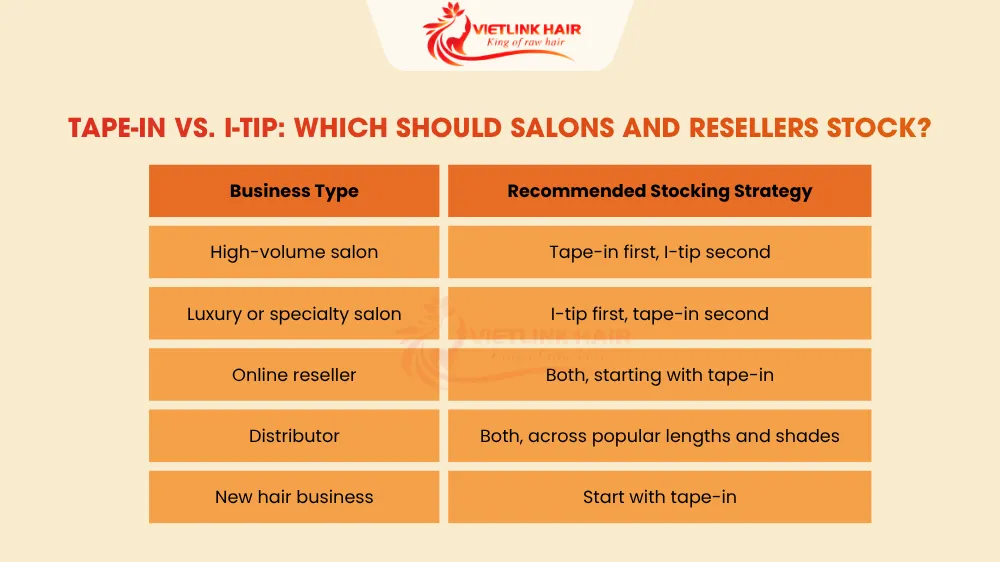
For salons and hair extension resellers, the right choice between tape-in and I-tip extensions depends on customer demand, service capacity, and inventory budget. Stocking both can help businesses reach more customers, but prioritizing the right product makes it easier to manage inventory and protect profit margins.
Tape-ins may appeal to salons with repeat fitting and refit appointments. Evaluate staff training, adhesive performance, demand and stock turnover before making them your core line.
I-tip extensions offer strand-by-strand placement and can suit salons with specialist bead-fitting expertise. Resellers should check demand for compatible tip sizes, bead specifications and individual strand pack formats.
| Business Type | Recommended Stocking Strategy | Main Reason |
|---|---|---|
| High-volume salon | Tape-in first, I-tip second | Faster appointments and easier staff training |
| Luxury or specialty salon | I-tip first, tape-in second | Flexible placement and premium service potential |
| Online reseller | Both, starting with tape-in | Broader customer reach and different price points |
| Distributor | Both, across popular lengths and shades | More complete product selection for salon clients |
| New hair business | Start with tape-in | Simpler initial product range and lower inventory complexity |
For salon owners and resellers comparing suppliers, a Vietnamese human hair supplier may be a sourcing option for wholesale human hair. Buyers can also review the Vietnamese hair factory overview before requesting product-specific details, availability and an itemised quotation.
Vietlink Hair works with wholesale buyers interested in human hair products and extension methods. Confirm the availability of tape-in and I-tip configurations, compatible tips, lengths, colours, quantities, packaging, production lead times and shipping terms before placing an order. Vietlink Hair’s stated wholesale MOQ is 500 g; confirm how it applies to your selected items.
FAQs
Are tape-in or I-tip extensions better for thin hair?
Tape-in panels can be discreet on some fine-hair clients, while I-tip attachments may be visible or place concentrated tension on small sections. Neither method is automatically safe for thin or fragile hair. A qualified stylist should assess density, hair health, attachment weight and placement before recommending either option.
Which lasts longer, tape-in or I-tip extensions?
I-tip and tape-in maintenance intervals depend on growth, attachment type and stylist guidance; tape-ins are often reviewed around 6–8 weeks, while I-tip schedules may differ. This is not the same as the lifespan of the extension hair. Both can sometimes be refitted if the hair and attachment components remain suitable.
Can tape-in and I-tip extensions be reused?
Both may be reusable when their condition and manufacturer guidance allow it. Tape-in wefts are professionally removed, cleaned and fitted with fresh adhesive; I-tip strands are released by opening the beads and may be refitted with compatible beads. Inspect hair, tips and attachments before every reuse rather than assuming a fixed number of cycles.
Which type is easier to maintain?
Both methods need gentle detangling, appropriate washing and scheduled professional checks. Tape-in bonds can be affected by oils and certain products near the adhesive. I-tip beads also need checks for slippage, matting and excess tension; follow product-specific aftercare instructions.
Are I-tip extensions better than tape-ins for swimming and workouts?
I-tip beads do not depend on adhesive, so they avoid the specific risk of tape bonds loosening when exposed to oils or moisture. However, swimming, sweat, salt and chlorine can still affect the extension hair, natural hair and attachment area. Neither method is maintenance-free or guaranteed to stay secure in water. Ask the stylist for product-specific care instructions, dry the roots thoroughly and have any slipping bonds or beads checked.
Which extension type is more profitable for salons and resellers?
Profitability depends on demand, stock turnover, installation labour, appointment capacity, refit revenue and product returns. Tape-ins may support shorter services; I-tips can suit specialist strand-by-strand appointments. Track contribution margin per service and sell-through by method before committing inventory to either range.
In conclusion, tape-in vs I-tip extensions both add length and volume, but suit different needs. Tape-in extensions offer relatively quick fitting and flat panels that may blend well when worn down. I-tip extensions provide individual strand placement that may better accommodate some updos. Neither method is automatically suitable for fragile hair, nor does either guarantee a longer maintenance interval. The best choice depends on hair type, lifestyle, maintenance requirements, and budget. For salons and resellers, stocking both types can help meet a wider range of customer preferences and business needs.
Source Tape-In or I-Tip Hair for Your Business
Tell Vietlink Hair your preferred attachment method, hair length, texture, colour, quantity and delivery country. Ask for current product compatibility, specifications, availability and a wholesale quotation.

Pingback: Natural Curly Hair With Extensions: A B2B Matching Guide