
Hair Extension Knowledge
How Long Do Extensions Last? Hair Care Secrets
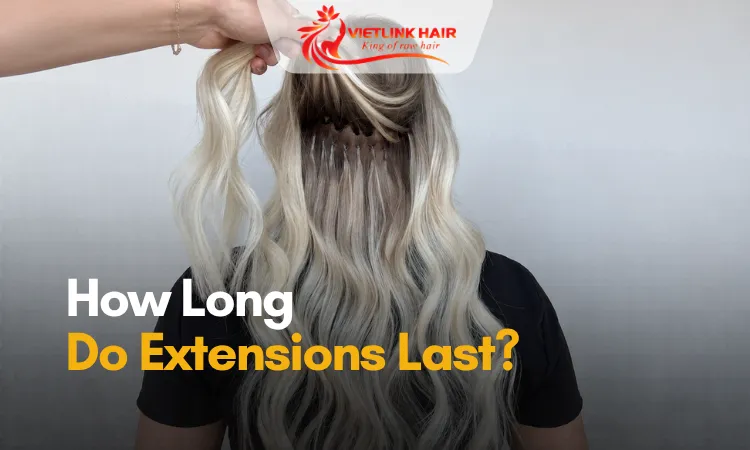
Extensions may look smooth and full at first but become dry or tangled after a few washes. For salons and distributors, this affects customer satisfaction and repeat orders. So, how long do extensions last in practice?
The answer depends on two factors: attachment wear time and total usable lifespan. Understanding both helps B2B buyers plan inventory, set pricing, and manage customer expectations.
How Long Do Extensions Last on Average?
Before comparing individual methods, it helps to separate the time extensions stay attached from the time the hair itself remains reusable.
Many human hair extensions stay usable for about 6 to 12 months with regular wear. Removable products and higher-grade hair can last longer. This is a planning estimate, not a guaranteed lifespan, because construction, care, and wearing habits all change the result.
Buyers usually mean one of two things: how often extensions need salon maintenance or how long the hair remains usable before replacement. A clear answer should cover both.
How Long Do Extensions Stay Attached to Natural Hair?
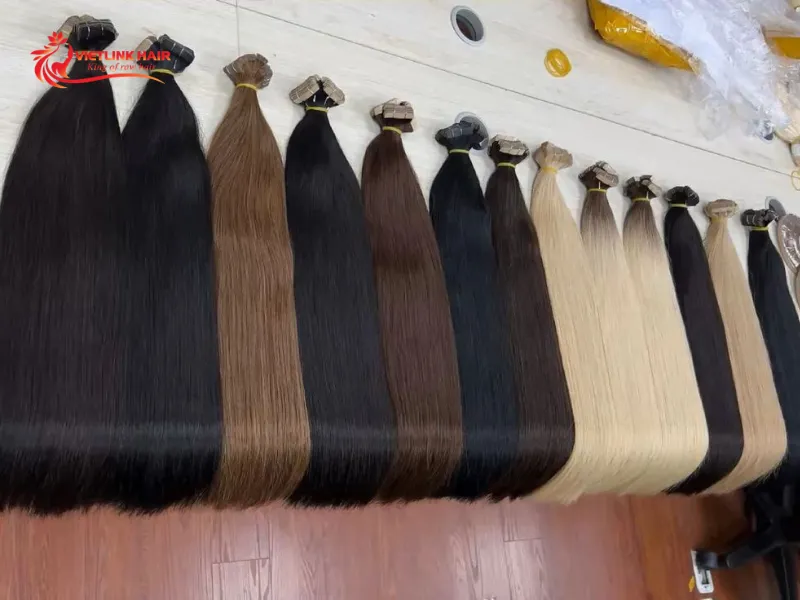
Attachment time depends on the method and on how quickly natural hair grows out. These are typical intervals before maintenance is needed:
- Tape-in: about 4 to 8 weeks.
- Sew-in or weft: about 6 to 8 weeks.
- I-tip or micro link: often 8 to 12 weeks, depending on installation and growth.
- Keratin bond: commonly 3 to 5 months per installation.
- Clip-in: removed after each wear, so there is no continuous installation to maintain.
How Long Does Extension Hair Remain Reusable?
Reusability is a separate question from attachment time. Hair can outlast any single installation if the attachment construction allows it to be removed and reinstalled.
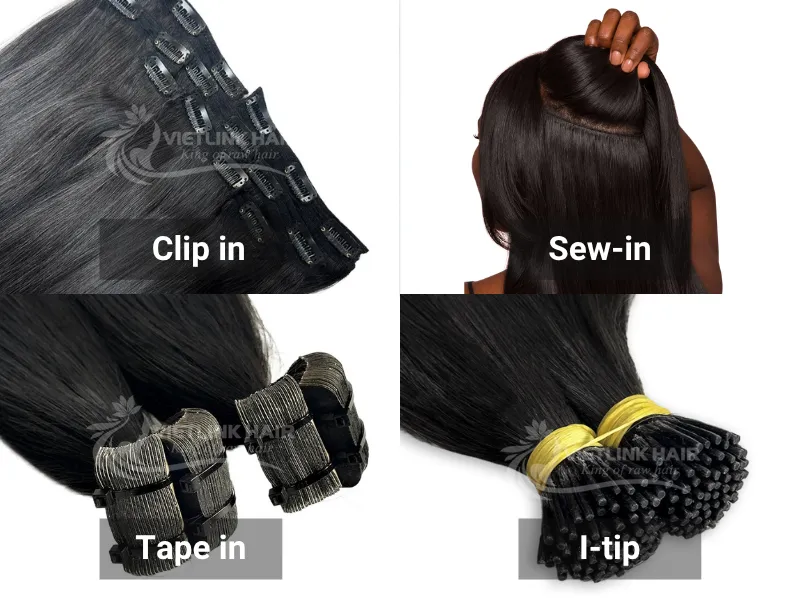
Removable clip-ins and reusable wefts are the easiest to reuse. Keratin bonds are usually one-time attachments, because the bond is consumed on removal. In short, how long do extensions last is partly decided by whether the attachment lets the hair return to service.
How Long Do Different Types of Hair Extensions Last?
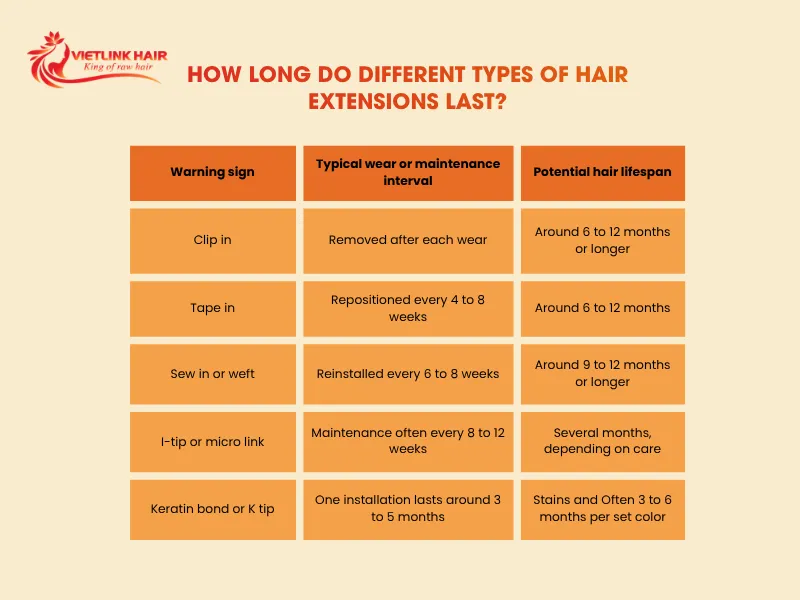
Once the two measurements are clear, how long do extensions last can be answered method by method, using wear time, maintenance schedule, and reuse potential.
| Extension type | Typical wear or maintenance interval | Potential hair lifespan |
| Clip in | Removed after each wear | Around 6 to 12 months or longer |
| Tape in | Repositioned every 4 to 8 weeks | Around 6 to 12 months |
| Sew in or weft | Reinstalled every 6 to 8 weeks | Around 9 to 12 months or longer |
| I-tip or micro link | Maintenance often every 8 to 12 weeks | Several months, depending on care |
| Keratin bond or K tip | One installation lasts around 3 to 5 months | Often 3 to 6 months per set |
These are planning ranges, not industry guarantees. Treat them as a starting point and confirm them against the specific product construction.
How Long Do Clip-In Extensions Last?
Clip-ins are the most forgiving format, so the main variables are clip quality and wearing frequency.
Because they come off at night, they face less continuous friction than fixed methods. Clip attachment quality, washing frequency, and storage all affect their life. A set worn for occasional events will usually outlast one worn every day.
How Long Do Tape-In Extensions Last?
Tape-ins use an adhesive sandwich around the natural hair, so lifespan depends on two parts: the tape and the hair.
The adhesive normally needs replacing at each repositioning, while the hair can often be reused. Product buildup and conditioner applied near the tape shorten the bond. Careful washing keeps the tape secure until the next appointment.
How Long Do Sew-In and Weft Extensions Last?
Wefts are built to be reinstalled, which makes thread integrity the main durability point.
Hand-tied, machine, and Genius weft constructions behave differently, but all rely on stitching that stays intact. The hair can be reused while the installation still needs regular tightening. Shedding and slow drying around the installed rows are early warning signs.
How Long Do Keratin Bond and I Tip Extensions Last?
Both methods attach single strands, but they differ in how they are secured and removed.
Keratin bonds are fused with heat or adhesive, while I tips are held by silicone-lined beads. Bond condition and bead slippage decide when maintenance is due. Both should be removed by a professional to protect the client’s natural hair.
→ Choosing between small ring attachments for your salon menu? Here’s the full breakdown of micro ring vs nano ring extensions
What Factors Affect How Long Hair Extensions Last?
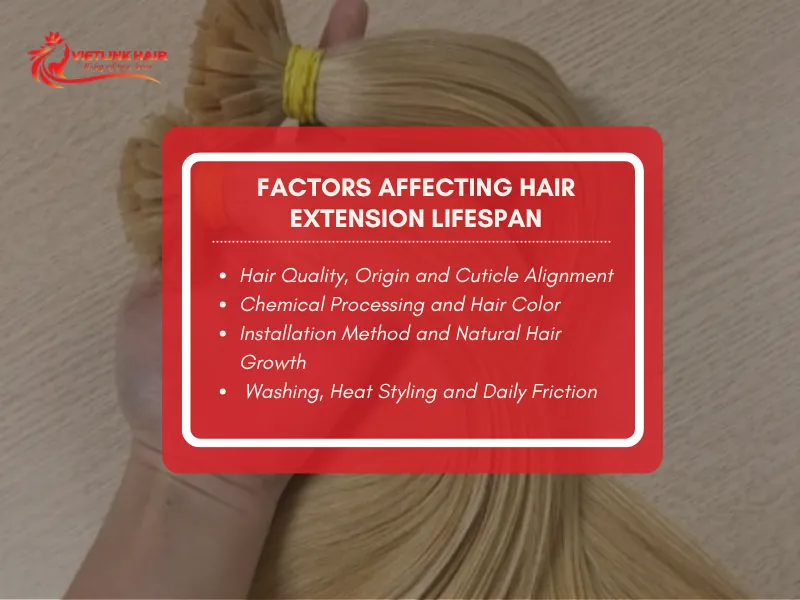
Extension type sets the starting point for how long do extensions last, but hair quality and conditions of use decide whether a product actually reaches it. Four factors matter most.
Hair Quality, Origin and Cuticle Alignment
Terminology needs to be accurate here. Raw hair is unprocessed hair collected from donors. Virgin hair has never been chemically treated. Remy hair keeps the cuticles aligned in one direction, and non-Remy hair does not.
Cuticle alignment is one of the clearest signals of how long do extensions last through repeated wash cycles. Aligned cuticles reduce friction between strands, which lowers tangling. A grade label alone does not prove durability, so test a sample after washing, drying, and detangling.
→ Want to know when super double drawn is worth the jump in price? Here’s the full breakdown
Chemical Processing and Hair Color
Bleaching, coloring and repeated chemical treatments weaken the hair structure. Darker, minimally processed hair generally has more strength in reserve than heavily lightened hair.
Heavy lightening often shortens how long do extensions last, because each chemical step removes some of the strand’s protective structure. That said, not all dark or raw hair lasts longer. Results depend on how the hair was prepared and handled before it reaches the client.
→ Planning to lighten stock before resale? Here’s the full breakdown of whether you can bleach human hair extensions
Installation Method and Natural Hair Growth
Tension, attachment size, and placement all change how long a set stays comfortable. Delaying maintenance lets extensions pull on the natural hair as it grows out.
Late maintenance can shorten how long extensions last, even when the hair is still in good shape. It also helps to separate two kinds of damage. Wear on the extension hair is a product issue, while strain on the client’s own hair is usually an installation or maintenance issue.
Washing, Heat Styling and Daily Friction
Frequent washing, rough detangling, and high heat all shorten lifespan. Overnight friction against pillows adds to dryness and tangling.
Heat and friction reduce how long extensions last faster than most buyers expect, because the damage builds quietly until the hair suddenly feels rough. Match care instructions to the product and installation method. A routine that suits clip-ins may be wrong for tape-ins.
How to Make Hair Extensions Last Longer
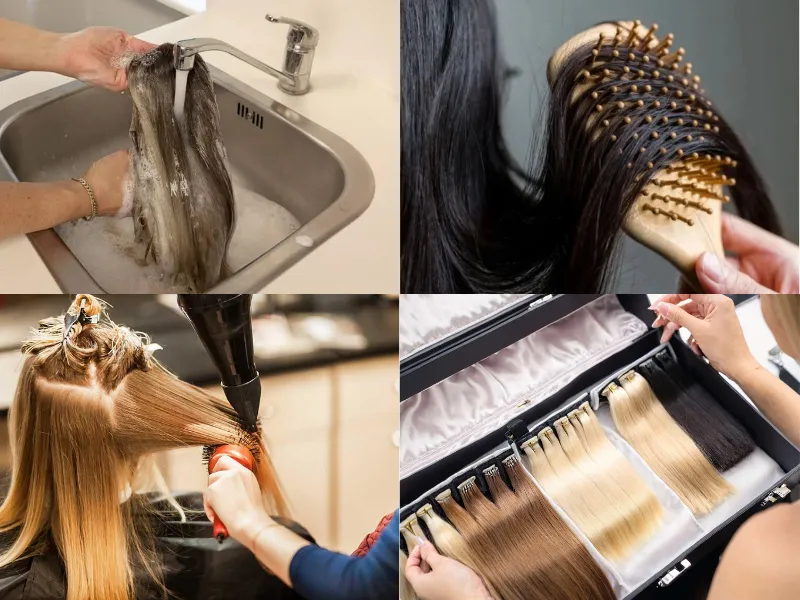
Several causes of early wear are preventable, so a clear aftercare routine helps preserve the hair and reduces avoidable replacements. Clients who ask how long do extensions last should hear this routine first.
The goal of how to make hair extensions last longer is simple: reduce friction, trapped moisture, and excess heat. The four habits below cover most of that.
Wash and Condition Extensions Correctly
Use a gentle shampoo and a suitable conditioner. Keep conditioners and oils away from adhesive attachment points.
Adjust the washing schedule to the method and to how much product buildup the hair collects.
Brush, Detangle and Dry Extensions Properly
Detangle from the ends upward while supporting the attachment area. Avoid aggressive brushing on wet or matted hair.
Dry both the hair and the installation thoroughly. Trapped moisture weakens attachments and encourages odor.
Reduce Heat Damage and Chemical Exposure
Use heat protection and moderate temperatures suited to the hair. Avoid repeated bleaching without checking the hair’s condition first.
Human hair can still be damaged by excessive processing, even when the quality is high.
Store Removable Extensions Correctly
Clean and dry removable pieces before storage. Keep them detangled and flat in a dry place.
Good storage limits friction, pressure, and humidity, which are the main causes of damage between wears. This is the easiest step in making hair extensions last longer for removable sets.
When Should You Replace or Reinstall Hair Extensions?
Even with consistent care, extensions wear out, so knowing how long do extensions last also means recognizing the signs that a set has reached the end. Use this checklist as a quick diagnostic.
| Warning sign | Likely issue | Recommended action |
| Attachment slips or grows out | Installation needs maintenance | Arrange a professional check |
| Persistent tangling after washing | Cuticle damage or buildup | Assess hair condition and clean appropriately |
| Excessive shedding | Construction or wear issue | Inspect the weft, bonds, or attachment points |
| Dry, brittle ends | Friction or processing damage | Trim if appropriate or assess replacement |
| Scalp pain or irritation | Tension or installation problem | Seek prompt professional assessment |
Maintenance can fix attachment problems. It cannot reverse serious structural damage to the hair. If a set needs repeated repairs, the hair has probably reached the end of its useful life.
How Long Do Extensions Last? A Wholesale Buyer’s Perspective
For salons, distributors, and private label brands, lifespan is not only a care question. It also affects repeat purchases, returns, and long-term margins. Buyers who understand how long do extensions last can price and promise more accurately.
Raw Hair vs. Processed Hair: Which Offers Better Long-Term Value?
Raw hair usually costs more upfront, while processed hair can look uniform at first but may need more maintenance and show wear sooner. The real trade-off is purchase cost against usable lifespan.
A lower price loses its appeal if the hair shortens how long do extensions last for your end clients. Treat raw, virgin, and Remy as separate terms, not as synonyms.
→ Is double-drawn worth the extra cost for your range? Here’s the full breakdown of what double-drawn hair is
How to Evaluate Extension Durability Before a Bulk Order
A structured sample test gives better data than a supplier’s promise. Follow this checklist:
- Request a sample from the intended production specification.
- Record the grade, length, texture, color, and processing requirements.
- Wash and dry the sample with a fixed, repeatable procedure.
- Check tangling, shedding, texture retention, and attachment construction.
- Compare samples from several bundles or batches.
- Request written specifications and ask how product claims are assessed.
Factory Insight: Why Hair Lifespan Should Be Tested Beyond Appearance
Appearance on day one tells you little, so this insight comes from how sample testing works in practice.
Manufacturer insight: A smooth, coated sample can feel excellent before washing, but initial softness does not prove durability. For wholesale evaluation, compare how samples behave after repeated washing, drying and detangling under the same conditions. Judge hair preparation, chemical processing, weft construction and batch consistency separately, and record the results instead of relying on a lifespan claim.
FAQs
The answers below cover common questions that remain after comparing extension methods, hair quality, and maintenance:
How long do extensions last if you wear them every day?
Daily wear increases friction and styling exposure, which can shorten lifespan. The effect still depends on the method and the care routine. A well-maintained fixed set can outlast a poorly cared-for removable one.
How long do human hair extensions last compared with synthetic extensions?
Human hair generally tolerates heat styling and can often be reused, while many synthetic fibers cannot be restyled with heat. Maintenance and reuse potential differ by product, so not every item in either category performs the same. Compare specific products, not just categories.
Do bleached hair extensions last as long as natural color extensions?
Often they do not, because chemical processing weakens the hair. Results vary with how the bleaching was done and how the finished product was prepared. Test the final product before committing to bulk volume.
How do you know when hair extensions are beyond repair?
Look for persistent matting, brittle strands, heavy shedding, and damaged attachment construction. When these appear together, repair rarely restores the hair.
Does better quality hair always last longer?
Quality matters, but it is only one input in how long do extensions last. Installation, processing, usage, and maintenance also shape the result. Premium hair handled poorly can wear out faster than average hair handled well.
Conclusion: Choose Hair Extensions for Their Expected Lifespan
Extension lifespan depends on hair quality, processing, construction, and aftercare.
For reliable wholesale hair and tailored specifications, contact Vietlink Hair to discuss your requirements and request samples before placing a bulk order.
WhatsApp: +84 855 555 951
Email: info@vietlinkhair.com
Facebook: Vietlinkhair
