
Hair Extension Knowledge
Halo vs Clip-In Hair Extensions: An In-Depth Comparison for Hair Buyers
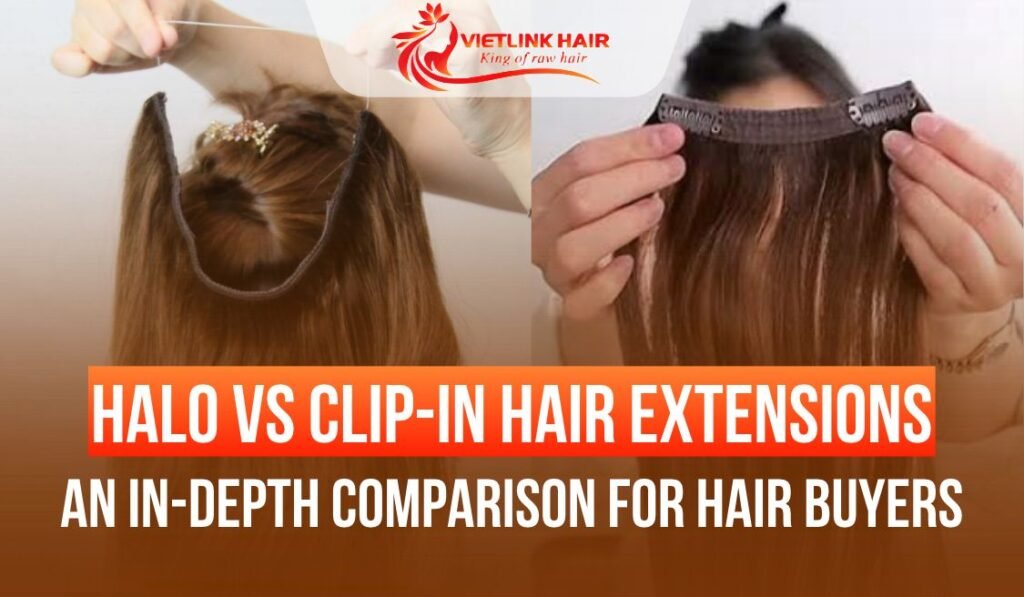
Halo vs clip-in hair extensions is a common comparison for anyone looking to add length, volume, and versatility to their hairstyle without committing to permanent extensions. Both options are popular for their convenience and ability to transform a look, but they differ in how they attach, how they blend with natural hair, and how much flexibility they offer for everyday wear and styling. In this guide, VietLink Hair compares the key differences between halo and clip-in hair extensions to help you understand each option and find the right fit for your needs.
What Are Halo and Clip-In Hair Extensions?
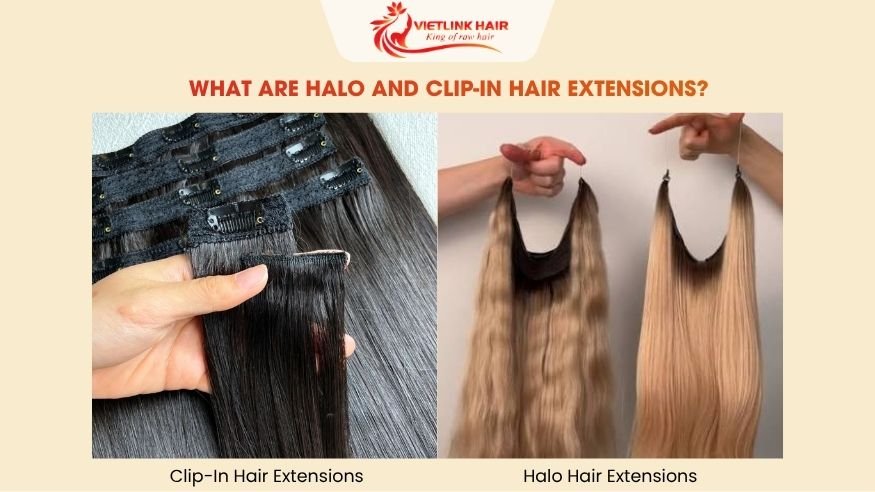
Halo hair extensions are a type of temporary hair extension made from a wide weft of hair attached to a thin, transparent wire. The wire sits around the head, while the wearer’s natural hair covers it to create a seamless blend. Unlike traditional extensions, halo extensions do not rely on clips to attach directly to the natural hair, although some designs include additional clips for a more secure fit.
Clip-in hair extensions consist of multiple hair wefts fitted with small clips that attach directly to sections of natural hair. The wefts come in different widths to add length and volume across specific areas of the head. They can be clipped in and removed without professional installation, making them a popular choice for temporary styling.
Both halo and clip-in hair extensions are available in synthetic fibers and human hair. For buyers seeking a natural appearance and greater styling flexibility, 100% human hair extensions are a popular option. Their performance and lifespan depend on hair quality, processing, and maintenance.
Key Differences Between Halo vs Clip-In Extensions
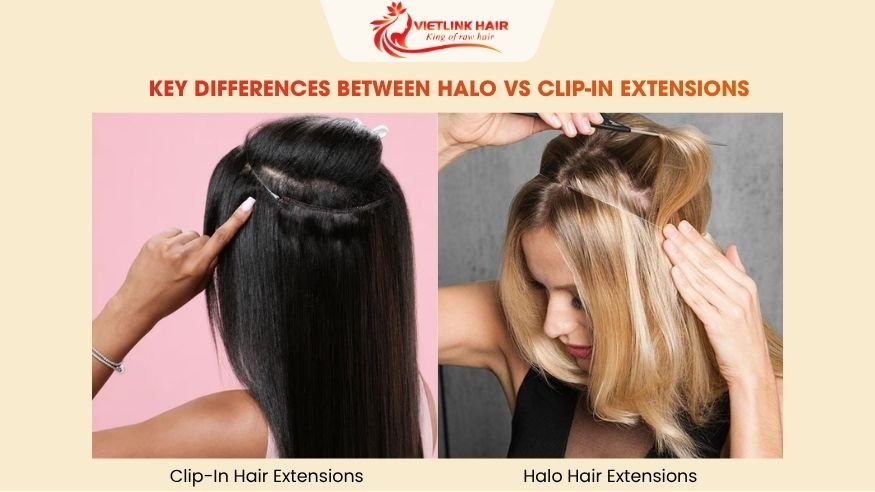
Halo and clip-in hair extensions are both temporary hair extensions, but they differ in structure, attachment method, application time, and styling flexibility. These differences affect how users apply the extensions, control volume, and choose products for personal use or retail.
| Feature | Halo Extensions | Clip-In Extensions |
| Structure | One main weft attached to a transparent wire; some sets include additional side pieces. | Multiple wefts in different widths, each fitted with clips. |
| Attachment Method | The wire rests around the head, and natural hair covers the wire and weft. | Small clips fasten the wefts to sections of natural hair. |
| Application Time | Generally takes a few minutes once the correct fit and placement are established. | Usually takes longer because the wearer must section the hair and attach each weft. |
| Typical lifespan with regular wear | Approximately 12 months | Approximately 6–12 months |
| Weight Options | Commonly available in different weights, often around 100–200 g, depending on the product. | Commonly available in different set weights, often around 100–220 g, depending on the product. |
| Available Lengths | Varies by brand and product, with options commonly spanning approximately 12–26 inches. | Varies by brand and product, with options commonly spanning approximately 14–26 inches. |
| Volume Control | Provides relatively uniform volume through a main weft, with limited adjustment to its distribution. | Allows users to add or remove individual wefts to adjust volume. |
| Volume Placement | Primarily adds overall length and fullness around the back and sides of the head. | Allows more targeted volume placement wherever individual wefts can be securely attached and concealed. |
| Fit and Security | Depends on wire adjustment, head shape, and how well natural hair covers the attachment. | Depends on clip placement, hair density, and how securely the clips grip natural hair. |
| Product Set Structure | Typically sold as a main halo piece in a selected color and length, sometimes with extra pieces. | Typically sold as a coordinated set of multiple wefts in a selected color, length, and total weight. |
The main difference is how each type delivers volume. Halo extensions offer a simpler, more integrated application, while clip-in extensions provide greater control over where extra hair is placed. The right option depends on the wearer’s hair type, desired result, and comfort with applying temporary extensions. Product specifications, including weight and available lengths, vary by manufacturer, so buyers should check individual product details before purchasing.
Pros and Cons of Halo and Clip-In Extensions
Halo and clip-in hair extensions each offer distinct advantages and limitations in terms of application, comfort, styling flexibility, and maintenance. Understanding these differences helps buyers determine which type best suits their needs.
Halo Hair Extensions
Pros
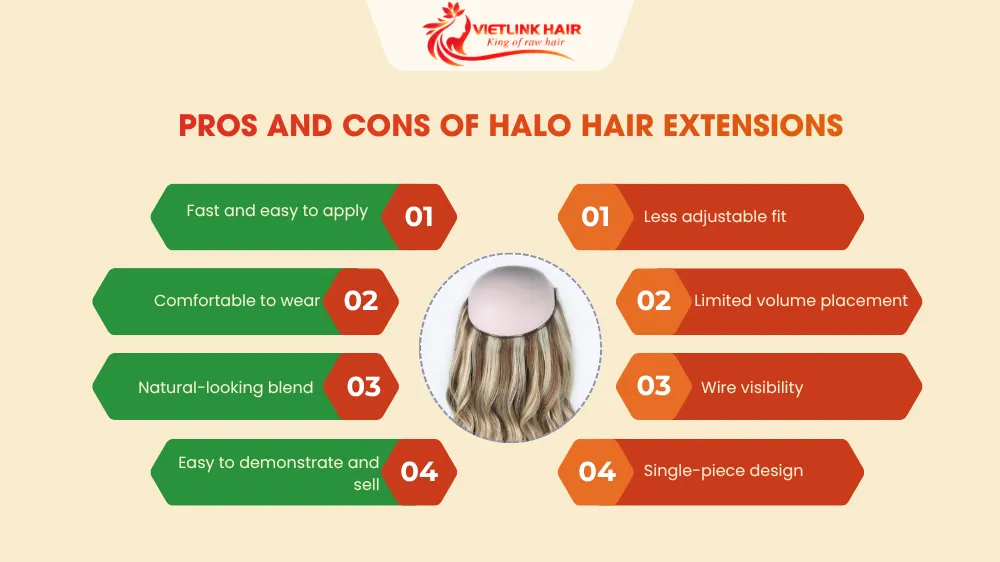
- Fast and easy to apply: Halo extensions do not require sectioning natural hair, making placement simple and reducing the chance of mistakes for first-time users.
- Comfortable to wear: Without clips clamping directly onto natural hair, halo extensions avoid clip-related pressure at the roots.
- Natural-looking blend: The main weft sits beneath the top layer of natural hair, which helps conceal the transparent wire and create a seamless appearance.
- Easy to demonstrate and sell: The one-piece design and straightforward application make halo extensions easy for stylists and retailers to demonstrate with before-and-after results.
Cons
- Less adjustable fit: A loose wire may shift during wear, while an overly tight fit can become uncomfortable over time.
- Limited volume placement: The main weft adds fullness primarily around the back and sides, offering less control over specific areas such as the hairline, crown, and nape.
- Wire visibility: The transparent wire may become visible with very sleek hairstyles, deep partings, or insufficient coverage from natural hair.
- Single-piece design: Damage to the main weft or supporting wire can affect the entire extension piece.
Clip-In Hair Extensions
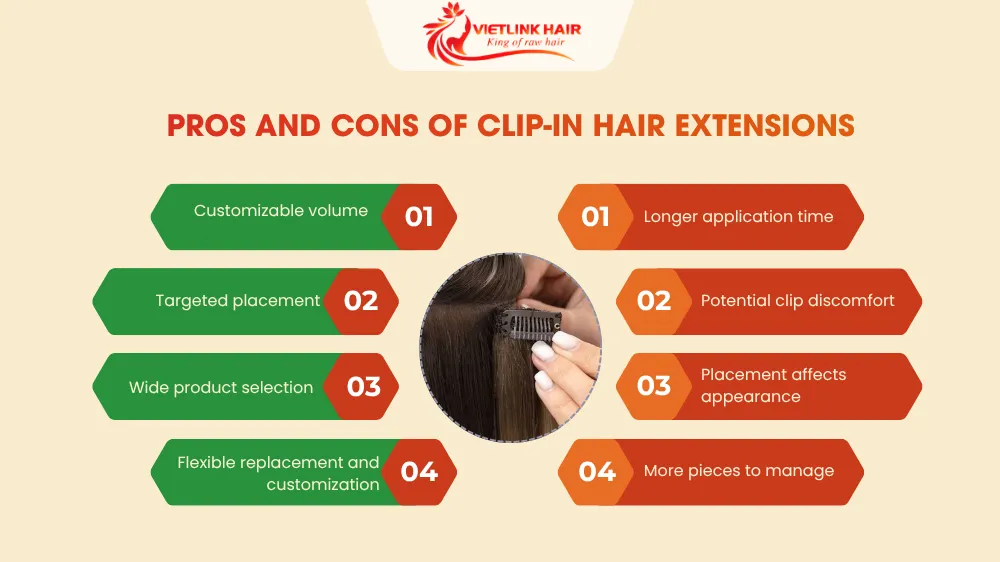
Pros
- Customizable volume: Users can apply just a few wefts for subtle fullness or use the complete set for a more dramatic transformation.
- Targeted placement: Individual wefts can be positioned to address specific needs, such as thinning sides, a flat crown, or layers that need additional length.
- Wide product selection: Clip-in extensions are available in various weights, lengths, colors, ombre shades, and highlight combinations.
- Flexible replacement and customization: Individual wefts can be replaced or adjusted without necessarily discarding the entire set. Recoloring or trimming depends on the hair quality and product construction.
Cons
- Longer application time: Sectioning the hair and attaching multiple clips takes more time, and achieving a natural result may require practice.
- Potential clip discomfort: Clips may press against the scalp, particularly for people with fine or sensitive hair or when leaning against a headrest.
- Placement affects appearance: Clips positioned too high or incorrectly may show through the top layer of natural hair.
- More pieces to manage: Multiple wefts require careful organization, storage, and handling to prevent tangling or damage.
Cost of Halo vs Clip-In Extensions
The cost of halo vs clip-in hair extensions depends on several factors, including hair quality, length, total weight, color, and supplier. Beyond the initial purchase price, buyers should also consider how long the extensions last, how frequently they will be worn, and how much flexibility they offer. The following price ranges and examples provide a general reference for comparing Vietnamese human hair extensions in the current market.
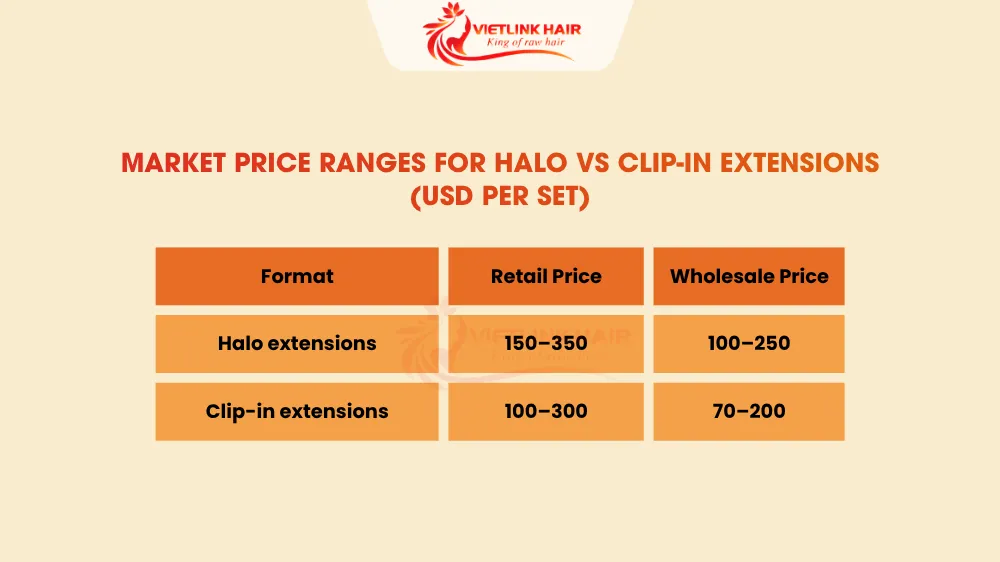
Market Price Ranges for Vietnamese Human Hair Extensions (USD per Set)
| Format | Retail Price | Wholesale Price | Typical Weight |
| Halo extensions | 150–350 | 100–250 | Approximately 100–200 g |
| Clip-in extensions | 100–300 | 70–200 | Approximately 100–220 g |
Retail Price Examples from an Established Human Hair Brand
| Product | Length and Weight | Price |
| Clip-in set | 16 inches, 140 g | 149–189 |
| Clip-in set | 20 inches, 120 g | 139–179 |
| Clip-in set | 20 inches, 160 g | 169–209 |
| Clip-in set | 20 inches, 220 g | 219–259 |
| Halo set | 20 inches, 180 g | $209 |
These examples illustrate how the price of halo and clip-in extensions can vary by format and product specifications. Halo extensions may have a higher starting price in some product ranges because of their construction and fixed-piece design. Clip-in extensions offer more weight options, allowing buyers to choose a lighter set for subtle volume or a heavier set for fuller coverage. However, prices vary by brand and hair quality, so these patterns should not be treated as universal.
Looking for a reliable wholesale hair extensions supplier? VietLink Hair Factory supplies Vietnamese human hair extensions for salons, retailers, and distributors, with options to suit different product requirements and budgets. Whether you are sourcing halo or clip-in extensions, contact VietLink Hair to discuss available products, request a quotation, and explore wholesale options for your business.
- WhatsApp: +84 855 555 951
Halo vs Clip-In: Which Is Better for Different Hair Types?
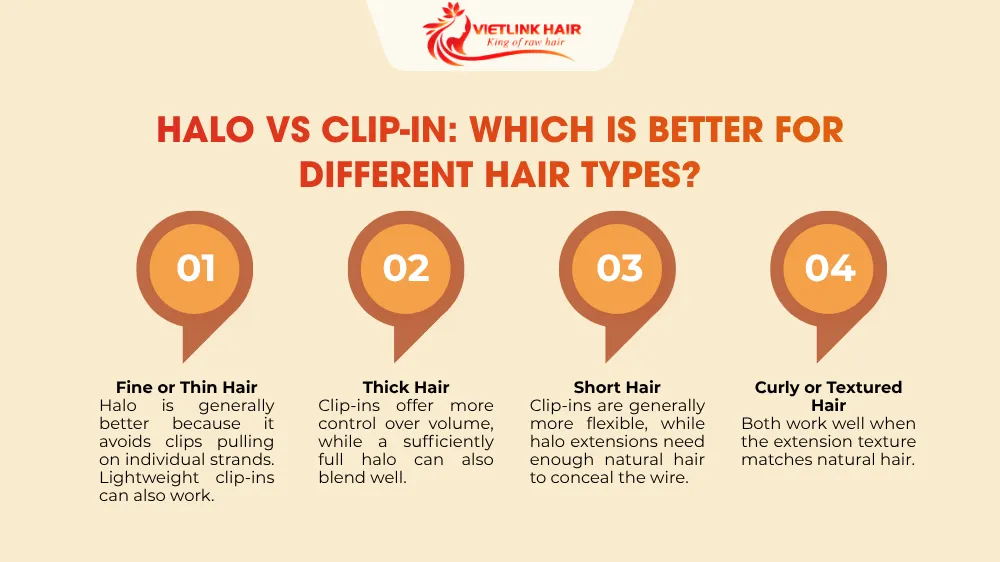
The best choice between halo and clip-in hair extensions depends on your natural hair’s thickness, length, and ability to conceal and support the extensions. The amount of weight your hair can comfortably support is also an important factor when choosing the right type.
1- Fine or Thin Hair
Halo is the first choice for fine hair. With no clips gripping individual strands, it puts less tension on fragile roots, and a lighter weft of about 100 to 140 g adds volume without dragging the hair down. Clip-ins can still work on fine hair if the set is seamless, the wefts are narrow, and only a few pieces are used, with clips placed at slightly thicker sections.
2- Thick Hair
Clip-ins are usually the better fit for thick hair, because matching the density of the wearer’s own hair needs more weight than a single halo weft can offer. Adding wefts is simple: a heavier set of 160 to 220 g blends into dense hair without looking sparse at the ends. A halo works on thick hair when the weight is high enough, and thick hair hides the wire easily.
3- Short Hair
Short hair limits both formats, but halo is more demanding because the natural hair has to fall over the wire. As a guide, halo works best when the natural hair reaches at least the shoulders, and a 12-inch halo is designed for hair that is shoulder-length up to about 12 inches. Clip-ins are more flexible for cuts like long bobs: short pieces of 14 to 16 inches can be clipped at the back and sides, and the set can be trimmed to blend.
4- Curly or Textured Hair
For curly or wavy hair, the deciding factor is texture matching. Both formats are available in straight and wavy textures, but a clip-in set is easier to blend because individual wefts can be curled or flat-ironed separately to match the wearer’s pattern and then set in place.
How to Put On and Care for Halo vs Clip-In Extensions
Proper application and maintenance help halo and clip-in hair extensions blend naturally with your hair while reducing tangling, shedding, and unnecessary stress on your natural hair. Although both are temporary extensions, halo extensions rely on a supporting wire, whereas clip-in extensions attach directly to natural hair with small clips. Follow the steps below to apply, remove, and care for each type correctly.
1- How to Put On Halo Extensions
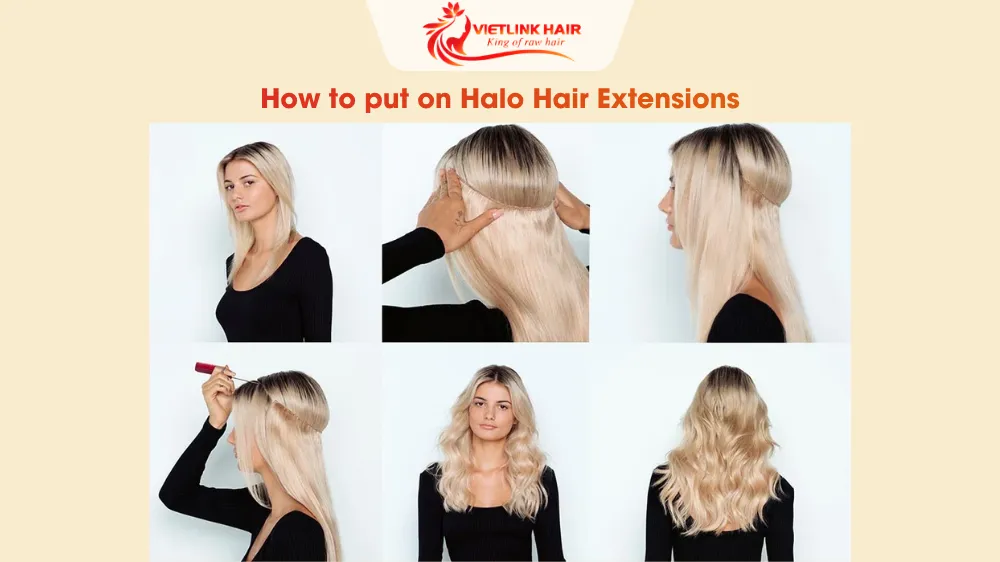
Halo hair extensions are designed for quick application without attaching the main weft directly to natural hair. Correct placement helps keep the wire concealed and the extension secure throughout wear.
- Brush and section your natural hair: Remove tangles, then create a horizontal part around the crown, approximately from ear to ear. Clip the upper section away to leave enough hair to cover the wire.
- Position the halo extension: Hold the extension with the wire facing your head and the weft hanging down. Place the wire across the crown, just behind the hairline.
- Adjust the fit: Slide the halo into position until it sits securely and comfortably around your head. Adjust the wire according to the manufacturer’s instructions, avoiding excessive tightness.
- Release the top section: Let your natural hair fall over the wire and main weft. If your set includes additional clip-in side wefts, attach them where needed to improve blending.
- Blend the hair: Gently comb your natural hair over the extension and blend the two together. Check the back and sides in a mirror to ensure the wire is concealed and the hair looks even.
2- How to Put On Clip-In Extensions
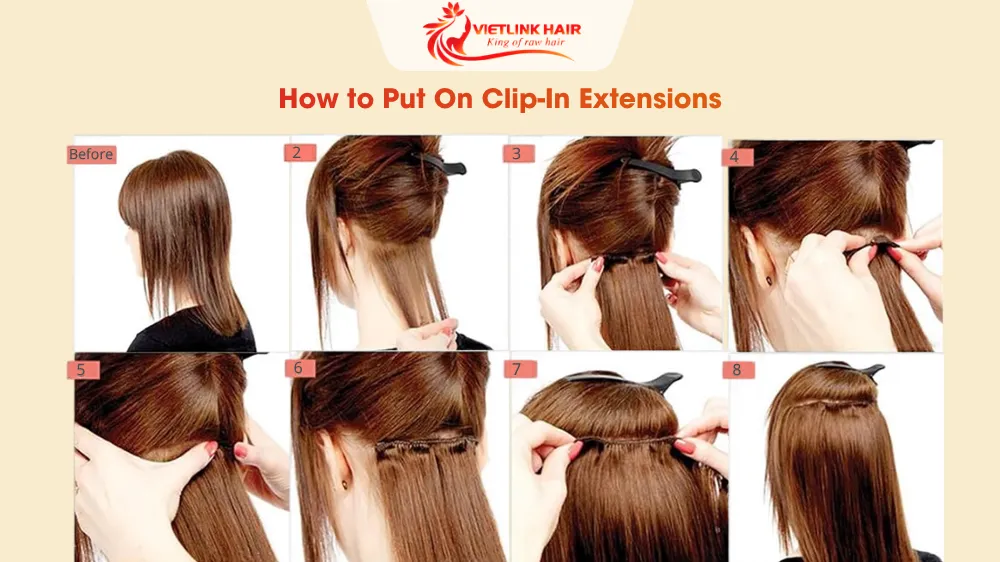
Clip-in hair extensions require more sectioning than halo extensions because each weft must be secured in the appropriate position. Correct placement helps distribute the weight evenly and prevents clips from showing through your natural hair.
- Prepare your natural hair: Brush out tangles and make sure your hair is dry. If extra grip is needed, lightly tease the roots at the attachment points, but avoid excessive teasing that could cause tangling or breakage.
- Attach the bottom weft: Create a horizontal part at the nape and clip the remaining hair up. Open the clips on the widest weft, position it along the part, and snap them closed securely without pulling on the scalp.
- Work upward in sections: Create additional horizontal parts approximately one inch apart, adjusting the spacing to suit your hair density and the size of each weft. Attach wider wefts across the back and use narrower pieces as needed.
- Add the side wefts: Place smaller wefts around the sides of the head, leaving enough distance from the hairline to keep the clips concealed. Avoid attaching them too close to the temples or areas with insufficient hair to support them.
- Blend and check the placement: Release the top layer of natural hair and gently brush through the extensions. Check from different angles to make sure the clips and wefts are hidden, the volume looks balanced, and no section feels too tight.
3- How to Care for Halo and Clip-In Hair Extensions
Both halo and clip-in extensions need gentle handling to maintain their appearance and reduce tangling. Care requirements vary depending on whether the extensions are made from human hair or synthetic fibers, so always follow the manufacturer’s instructions.
- Detangle before and after wearing: Use a loop brush designed for extensions or a suitable wide-tooth comb. Start at the ends and work upward in small sections, supporting the hair to minimize pulling.
- Wash when needed: Wash human hair extensions when product buildup, oil, or dirt accumulates rather than following a rigid schedule. For frequently worn extensions, this may be approximately every 10–15 wears. Use lukewarm water and a gentle shampoo suitable for the hair.
- Condition the lengths and ends: Apply conditioner mainly to the mid-lengths and ends. Avoid saturating the weft stitching, attachment points, or clips, as product buildup can affect the construction and performance of the extensions.
- Dry thoroughly: Gently remove excess water with a towel, then allow the extensions to air-dry fully on a suitable hanger or flat surface. Avoid storing them while damp, as trapped moisture can encourage mildew and cause unpleasant odors.
- Remove before sleeping, showering, or swimming: Halo and clip-in extensions are designed for temporary wear. Removing them before these activities helps reduce tangling, unnecessary pulling, and exposure to moisture or chemicals.
- Store them properly: Hang halo extensions on a suitable hanger or place them in a clean storage box. For clip-in sets, close the clips before storing the wefts neatly on a hanger or flat in a storage case to help prevent tangling and damage.
Expert tip: Never force a halo wire into an uncomfortable position or pull clip-in extensions away from the scalp. If the extensions slip, feel heavy, or cause discomfort, remove them and adjust the fit or placement before wearing them again.
FAQs
Are halo extensions better than clip-ins?
Neither is better in every case. Halo extensions are better for speed, comfort, and a seamless crown, while clip-ins are better for custom placement and adjustable fullness. The right choice depends on hair density, hair length, and how much time the wearer wants to spend. Wearers who want the easiest routine usually prefer a halo, and those who want control prefer clip-ins.
What are the best halo or clip-in hair extensions for thin hair?
The best option for thin hair is lightweight, seamless human hair. For a halo, choose a total weight of about 100 to 140 g and a color-matched weft. For clip-ins, choose a seamless set of 100 to 120 g with narrow wefts and silicone-lined clips. Avoid heavy sets, because extra weight pulls on fine hair and makes the join more visible.
Can you wear your hair up with halo extensions?
Yes, with limits. Low ponytails, low buns, and half-up styles work well, because the natural hair still covers the wire. High ponytails and tight updos can expose the wire or weft at the back, so leave a section of natural hair loose at the crown and curl or smooth it over the join. Clip-ins offer more flexibility for fully tied-back styles when the wefts are placed low.
Do halo or clip-in extensions damage natural hair?
Neither format uses heat, glue, or tape on the hair, so neither causes bonding damage, but damage can still happen. The main causes are tight clips on fine hair, heavy sets, sleeping in the extensions, and pulling them out roughly. Choose a suitable weight, take them out before sleeping, and release the clips or wire gently, and your natural hair should stay healthy.
Can you curl or straighten Halo vs Clip-In Hair Extensions?
Yes, if they are made of real human hair. Use a heat protectant, keep tools at about 150 to 180°C (300 to 350°F), and style the hair off the head, laying clip-in wefts flat and hanging the halo from a hook. Let the hair cool before wearing it so the shape sets. Synthetic extensions generally cannot be heat-styled unless they are labeled as heat-resistant.
Halo vs. clip-in: Which hair extensions are more popular with customers?
Clip-ins are the more established and widely stocked format, with a larger range of weights, lengths and shades. Halos have grown quickly in recent years because they are fast and easy to apply, particularly for first-time wearers. For a business, the best guide is its own sales data and client questions, which show whether customers ask for convenience or customization.
In conclusion, choosing between halo vs clip-in hair extensions depends on the desired look, comfort, styling flexibility, and budget. Halo extensions are ideal for buyers who prioritize quick application and an easy-to-manage design, while clip-in extensions offer greater control over volume placement and customization. For both options, hair quality, proper fit, and maintenance play an important role in achieving a natural look and extending product lifespan.
